22 November 2026: what is new up there
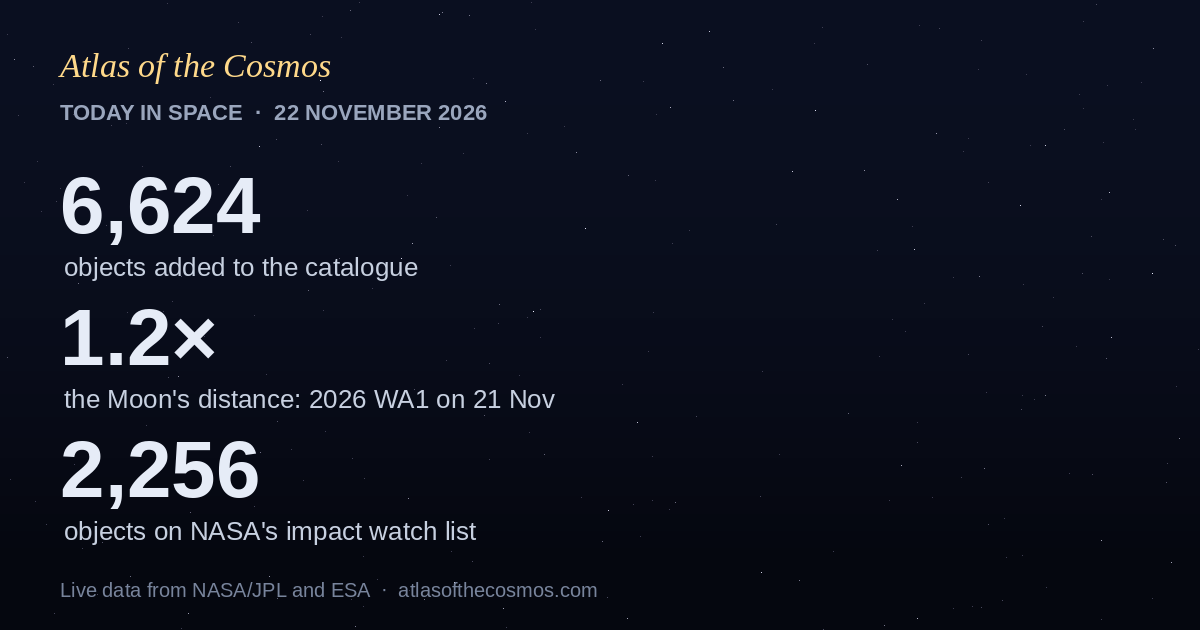
On 22 November 2026, NASA/JPL's catalogue of asteroids and comets held 1,593,061 objects, 6,624 more than the day before. This week's closest known pass of Earth is 2026 WA1, about 5 m across, which passed 475,058 km from Earth (1.2 times the Moon's distance) on 21 November 2026 at 13.7 km/s. NASA's Sentry system lists 2,256 objects with any chance of hitting Earth in the coming decades to centuries, and ESA lists 2,215. None is expected to hit.
Close passes of Earth
| Object | Size | Date | Distance | Moon distances | Speed |
|---|---|---|---|---|---|
| 2026 WA1 | ~5 m | 2026-11-21 | 475,058 km | 1.2 | 13.7 km/s |
| 2026 WJ | ~15 m | 2026-11-22 | 645,487 km | 1.7 | 9.2 km/s |
| 2026 WB1 | ~10 m | 2026-11-21 | 732,073 km | 1.9 | 14.0 km/s |
| 2026 VQ19 | ~30 m | 2026-11-26 | 1,514,309 km | 3.9 | 6.8 km/s |
| 2026 WD | ~15 m | 2026-11-23 | 1,706,668 km | 4.4 | 13.9 km/s |
| 2026 VQ5 | ~60 m | 2026-11-25 | 2,008,548 km | 5.2 | 11.7 km/s |
Newly found objects
22 objects were first seen in the last three days, nearly all of them small near-Earth asteroids (only those come close enough to be spotted so faint). The most recent:
- 2026 WW1, about 110 m across, first seen 2026-11-21
- 2026 WN1, about 10 m across, first seen 2026-11-20
- 2026 WQ1, about 15 m across, first seen 2026-11-20
- 2026 WP1, about 20 m across, first seen 2026-11-20
- 2026 WS1, about 20 m across, first seen 2026-11-20
- 2026 WA1, about 5 m across, first seen 2026-11-19
- 2026 WB1, about 10 m across, first seen 2026-11-19
- 2026 WU, about 10 m across, first seen 2026-11-19
Top of the impact watch list
Ranked by the Palermo scale, which weighs the odds by size and how soon. Anything below −2 is routine; a value above 0 would deserve real concern, and none is.
| Object | Size | Odds of a hit | Years | Palermo |
|---|---|---|---|---|
| 29075, 1950 DA | 1,300 m | 1 in 2,940 | 2880-2880 | -0.98 |
| 101955 Bennu, 1999 RQ36 | 490 m | 1 in 1,749 | 2178-2290 | -1.40 |
| 2008 JL3 | 29 m | 1 in 6,031 | 2027-2122 | -2.38 |
| 1979 XB | 660 m | 1 in 1,174,376 | 2056-2113 | -2.69 |
| 2000 SG344 | 37 m | 1 in 365 | 2069-2122 | -2.76 |
Found again
- P/2004 V5-A (LINEAR-Hill): seen again on 2026-11-16, last seen 2006-05-25
- P/2004 V5-B (LINEAR-Hill): seen again on 2026-11-15, last seen 2006-05-25
- 2007 WK3: seen again on 2026-11-15, last seen 2007-11-20
- 2010 BC3: seen again on 2026-11-20, last seen 2010-05-13
- 2012 TQ256: seen again on 2026-11-20, last seen 2012-12-17
- 373135: seen again on 2026-11-16, last seen 2015-12-09
Coming up in the sky
- 2026-11-26: Uranus at opposition. Uranus is opposite the Sun: up all night and at its brightest (magnitude 5.6), 18.44 au from Earth.
- 2026-12-14: Geminids peak. Up to about 150 meteors an hour under a perfectly dark sky; the Moon is 22% lit, so a good year.
- 2026-12-22: Ursids peak. Up to about 10 meteors an hour under a perfectly dark sky; the Moon is 97% lit, so a poor year: moonlight drowns the faint ones.
- 2027-01-03: Venus at its farthest from the Sun. Venus is 47° from the Sun in the morning sky, before sunrise: the best time to find it (magnitude -4.5).
- 2027-01-03: Quadrantids peak. Up to about 110 meteors an hour under a perfectly dark sky; the Moon is 13% lit, so a good year.
- 2027-02-06: next annular solar eclipse, up to 7 min 48 s
Oddity of the day
6144 Kondojiro: Number 23 on our strangeness ranking. It is far bigger than anything else on its kind of orbit (2.7 magnitudes clear of the tenth brightest).
See it all on the live 3D mapCite this page: “Today in space, 22 November 2026”, Atlas of the Cosmos, https://www.atlasofthecosmos.com/today/2026-11-22
Sources: NASA/JPL Small-Body Database; NASA/JPL Center for Near-Earth Object Studies (CNEOS) close approaches and Sentry; ESA NEO Coordination Centre risk list; JPL Horizons. Sizes are estimated from brightness and are good to about a factor of two. Data for this page: 2026-11-22.json. Text, data and images: CC BY 4.0, credit Atlas of the Cosmos. All days · About the data