Where are the spacecraft now? Voyager, New Horizons, JWST and more, today
By David Turner · Last updated 2026-11-23
Voyager 1 is 25.91 billion km from Earth today, 23 November 2026. Its radio signals take 24.0 hours to reach us. Here is where 16 deep-space missions are today, from NASA/JPL's tracking data, updated daily.
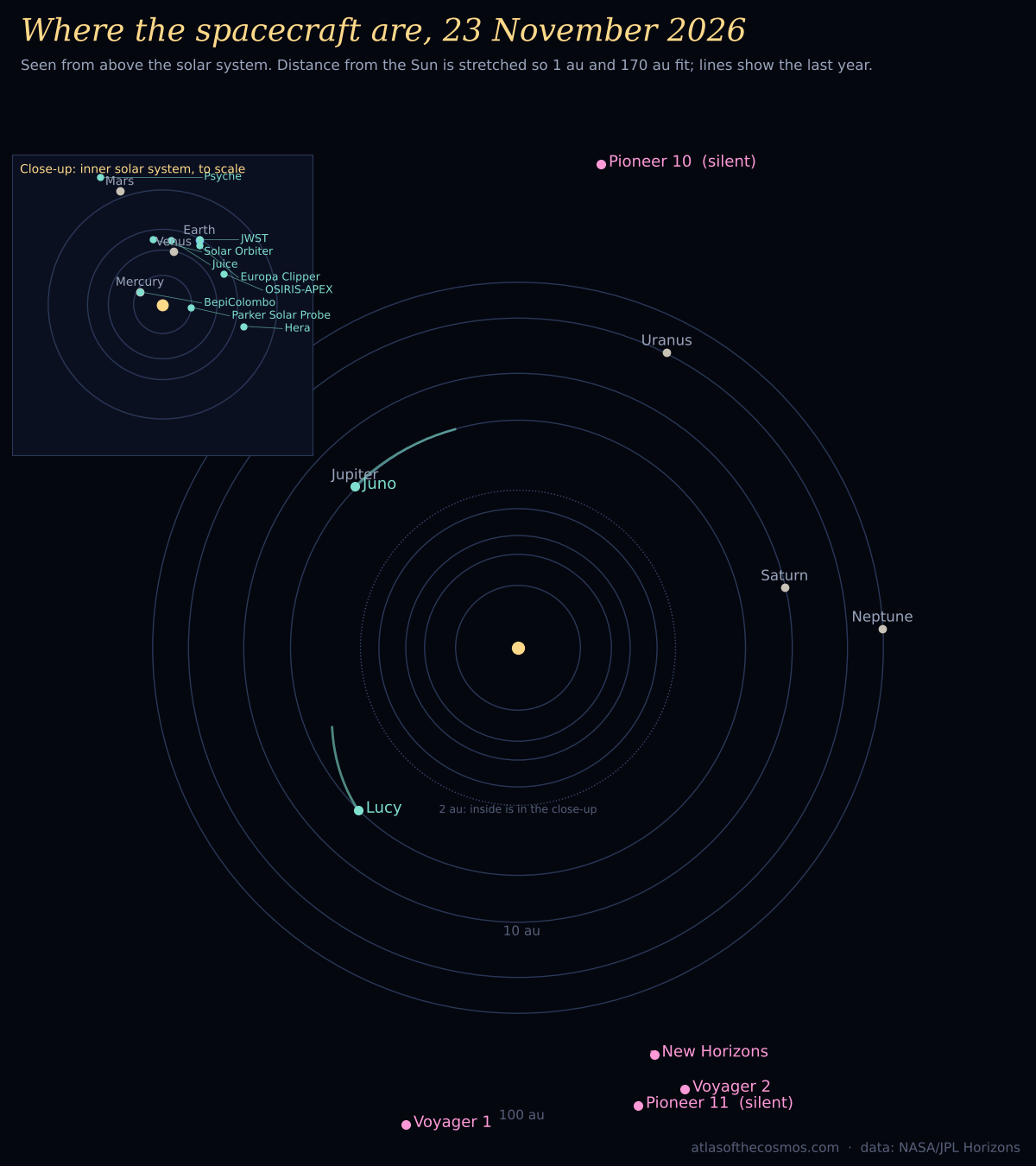
Right now Voyager 1 is 25,795,735,332 km from the Sun, adding 16.9 km every second.
| Spacecraft | From the Sun (au) | From Earth (million km) | Signal delay | Speed (km/s, around the Sun) |
|---|---|---|---|---|
| Voyager 1 | 172.43 | 25,911.7 | 24.0 h | 16.9 |
| Voyager 2 | 144.55 | 21,697.8 | 20.1 h | 15.3 |
| Pioneer 10 | 142.29 | 21,147.7 | 19.6 h | 11.8 |
| Pioneer 11 | 118.29 | 17,798.8 | 16.5 h | 11.1 |
| New Horizons | 66.13 | 9,991.4 | 9.3 h | 13.6 |
| Juno | 5.32 | 770.4 | 42.8 min | 13.0 |
| Lucy | 5.23 | 925.9 | 51.5 min | 8.6 |
| Psyche | 1.89 | 234.9 | 13.1 min | 22.8 |
| Hera | 1.11 | 193.0 | 10.7 min | 32.4 |
| James Webb Space Telescope | 1.00 | 1.7 | 0.1 min | 30.2 |
| Europa Clipper | 0.92 | 11.0 | 0.6 min | 37.0 |
| OSIRIS-APEX | 0.91 | 82.5 | 4.6 min | 33.3 |
| Solar Orbiter | 0.89 | 95.6 | 5.3 min | 22.7 |
| Juice | 0.87 | 56.5 | 3.1 min | 38.8 |
| Parker Solar Probe | 0.37 | 134.8 | 7.5 min | 49.9 |
| BepiColombo | 0.35 | 157.2 | 8.7 min | 52.7 |
How far away is Voyager 1?
25,911,740,359 km from Earth (173.2 times the Earth–Sun distance) and 25,795,735,332 km from the Sun. A radio message takes 24.0 hours each way, so a question and its answer take two days. It moves 3.6 au further from the Sun each year. Seen from Earth, the distance also wobbles by about 2 au as Earth goes round the Sun.
Voyager 1
172.43 au from the Sun · 25,911,740,359 km from Earth · 16.9 km/s
Launched 5 September 1977. Flew past Jupiter and Saturn, crossed into interstellar space in August 2012, and is the most distant human-made object. In November 2026 it became the first to be more than one light-day from Earth. Its power is fading, so instruments are being switched off one by one.
Voyager 2
144.55 au from the Sun · 21,697,828,007 km from Earth · 15.3 km/s
Launched 20 August 1977. Still the only spacecraft to have visited Uranus (1986) and Neptune (1989). It crossed into interstellar space in November 2018.
Pioneer 10
142.29 au from the Sun · 21,147,710,450 km from Earth · 11.8 km/s
Launched March 1972, the first spacecraft to cross the asteroid belt and fly past Jupiter. Its last faint signal came in January 2003, and this is where it should be now.
Pioneer 11
118.29 au from the Sun · 17,798,756,427 km from Earth · 11.1 km/s
Launched April 1973, the first to fly past Saturn. Contact ended in 1995, and this is where it should be now.
New Horizons
66.13 au from the Sun · 9,991,431,333 km from Earth · 13.6 km/s
Launched January 2006. Flew past Pluto on 14 July 2015 and the Kuiper belt object Arrokoth on 1 January 2019, the most distant object ever visited.
Juno
5.32 au from the Sun · 770,442,271 km from Earth · 13.0 km/s
Launched August 2011, in orbit around Jupiter since 4 July 2016, diving low over its poles.
Lucy
5.23 au from the Sun · 925,902,927 km from Earth · 8.6 km/s
Launched October 2021 to visit the Trojan asteroids that share Jupiter's orbit. It has flown past the asteroids Dinkinesh (2023) and Donaldjohanson (2025); the Trojans start in 2027.
Psyche
1.89 au from the Sun · 234,922,625 km from Earth · 22.8 km/s
Launched 13 October 2023 to the metal-rich asteroid Psyche. It used a pass of Mars in 2026 and arrives in 2029.
Hera
1.11 au from the Sun · 192,980,264 km from Earth · 32.4 km/s
ESA's mission to the asteroid pair Didymos and Dimorphos, launched October 2024, to measure exactly what NASA's DART impact did to Dimorphos in 2022.
James Webb Space Telescope
1.00 au from the Sun · 1,692,123 km from Earth · 30.2 km/s
Launched 25 December 2021. It orbits the Sun–Earth L2 point, about 1.5 million km from Earth on the side away from the Sun.
Europa Clipper
0.92 au from the Sun · 10,959,396 km from Earth · 37.0 km/s
Launched 14 October 2024 to study Jupiter's ice-covered moon Europa and its hidden ocean. It swung past Mars in March 2025 and uses a pass of Earth in December 2026 to reach Jupiter in 2030.
OSIRIS-APEX
0.91 au from the Sun · 82,512,473 km from Earth · 33.3 km/s
The spacecraft that brought samples of asteroid Bennu to Earth in 2023, renamed and sent on to meet Apophis just after its close pass of Earth in April 2029.
Solar Orbiter
0.89 au from the Sun · 95,625,842 km from Earth · 22.7 km/s
An ESA–NASA mission launched February 2020; its orbit is tilting steadily so it can see the Sun's poles, which no spacecraft had photographed before.
Juice
0.87 au from the Sun · 56,539,329 km from Earth · 38.8 km/s
ESA's Jupiter Icy Moons Explorer, launched April 2023. A chain of flybys of the Moon, Earth and Venus sends it to Jupiter in 2031, where it will end up orbiting Ganymede.
Parker Solar Probe
0.37 au from the Sun · 134,844,066 km from Earth · 49.9 km/s
Launched August 2018, it dives through the Sun's outer atmosphere. On 24 December 2024 it passed 6.1 million km from the Sun's surface at about 690,000 km/h, the fastest any human-made object has gone.
BepiColombo
0.35 au from the Sun · 157,189,381 km from Earth · 52.7 km/s
A European–Japanese mission to Mercury, launched October 2018, after a long chain of flybys of Earth, Venus and Mercury.
Open it on the live mapCite this page: “Where are the spacecraft now? Voyager, New Horizons, JWST and more, today”, Atlas of the Cosmos, updated 2026-11-23, https://www.atlasofthecosmos.com/spacecraft/. The figures are also data (JSON).
Sources: NASA/JPL Horizons spacecraft trajectories (Sun-centred, ecliptic), fetched daily; NASA and ESA mission pages. Reuse under CC BY 4.0 with credit to Atlas of the Cosmos. About the data