How far away is Saturn? Distance today, facts and when to see it
By David Turner · Last updated 2026-11-23
Saturn is 1,314 million km (8.78 au) from Earth today, 23 November 2026; its light takes 73.1 minutes to reach us. Over the next three years it comes as close as 1,219 million km (14 November 2029) and goes as far as 1,553 million km.
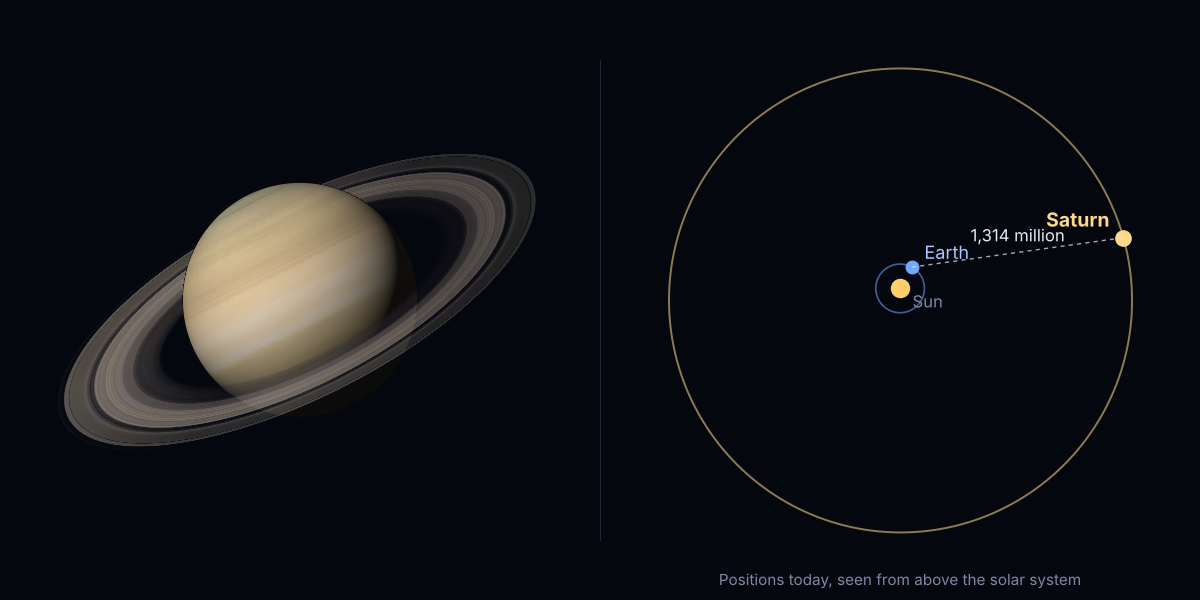
The ringed planet. Its rings are 270,000 km across but mostly only about 10 m thick, and it has more known moons than any other planet.
| Distance from Earth today | 1,314,151,731 km (8.785 au) |
|---|---|
| Light travel time | 73.1 minutes |
| In the sky now | in the evening sky |
| Diameter | 120,536 km (9.45 × Earth) |
| Mass | 95.2 × Earth |
| Gravity | 9.0 m/s² (0.92 × Earth) |
| Length of a day (sunrise to sunrise) | 10 hours 42 minutes |
| Length of a year | 29.4 years |
| Average temperature | -140 °C |
| Average distance from the Sun | 1,432.0 million km |
| Moons | 293 known |
Why does the distance to Saturn change so much?
Both planets go round the Sun at different speeds, so the gap swings between when they are on the same side of the Sun and when they are on opposite sides. From 23 November 2026 to 24 November 2029 it ranges from 1,219 to 1,553 million km, a factor of 1.3.
How long does it take to get to Saturn?
Light takes 73.1 minutes today. Cassini took 6 years 9 months (1997 to 2004), using flybys of Venus twice, Earth and Jupiter. Spacecraft never fly straight there. They follow curved orbits around the Sun, timed so the planet is waiting when they arrive.
When is Saturn best seen?
- 8 April 2027: behind the Sun (conjunction), and hidden for a few weeks either side
- 18 October 2027: opposition. Opposite the Sun, it is up all night and at its brightest, 1,246 million km away
- 21 April 2028: behind the Sun (conjunction), and hidden for a few weeks either side
- 31 October 2028: opposition. Opposite the Sun, it is up all night and at its brightest, 1,232 million km away
- 5 May 2029: behind the Sun (conjunction), and hidden for a few weeks either side
- 14 November 2029: opposition. Opposite the Sun, it is up all night and at its brightest, 1,219 million km away
Saturn’s distance from Earth over the next three years
| Date | Million km | Light time |
|---|---|---|
| 23 November 2026 | 1,314 | 73.1 minutes |
| 23 January 2027 | 1,458 | 81.0 minutes |
| 25 March 2027 | 1,549 | 86.1 minutes |
| 25 May 2027 | 1,513 | 84.1 minutes |
| 25 July 2027 | 1,379 | 76.7 minutes |
| 24 September 2027 | 1,259 | 70.0 minutes |
| 24 November 2027 | 1,276 | 71.0 minutes |
| 24 January 2028 | 1,413 | 78.5 minutes |
| 25 March 2028 | 1,525 | 84.8 minutes |
| 25 May 2028 | 1,516 | 84.3 minutes |
| 25 July 2028 | 1,397 | 77.6 minutes |
| 24 September 2028 | 1,262 | 70.1 minutes |
| 24 November 2028 | 1,245 | 69.2 minutes |
| 24 January 2029 | 1,368 | 76.0 minutes |
| 26 March 2029 | 1,496 | 83.2 minutes |
| 26 May 2029 | 1,516 | 84.3 minutes |
| 26 July 2029 | 1,416 | 78.7 minutes |
| 25 September 2029 | 1,272 | 70.7 minutes |
Cite this page: “How far away is Saturn? Distance today, facts and when to see it”, Atlas of the Cosmos, updated 2026-11-23, https://www.atlasofthecosmos.com/planets/saturn. The figures are also data (JSON).
Sources: NASA Planetary Fact Sheet; positions from JPL's approximate planetary orbits (Standish), good to a fraction of a degree. Reuse under CC BY 4.0 with credit to Atlas of the Cosmos. About the data · All planets