How far away is Mercury? Distance today, facts and when to see it
By David Turner · Last updated 2026-11-23
Mercury is 157 million km (1.05 au) from Earth today, 23 November 2026; its light takes 8.7 minutes to reach us. Over the next three years it comes as close as 82 million km (2 June 2028) and goes as far as 217 million km.
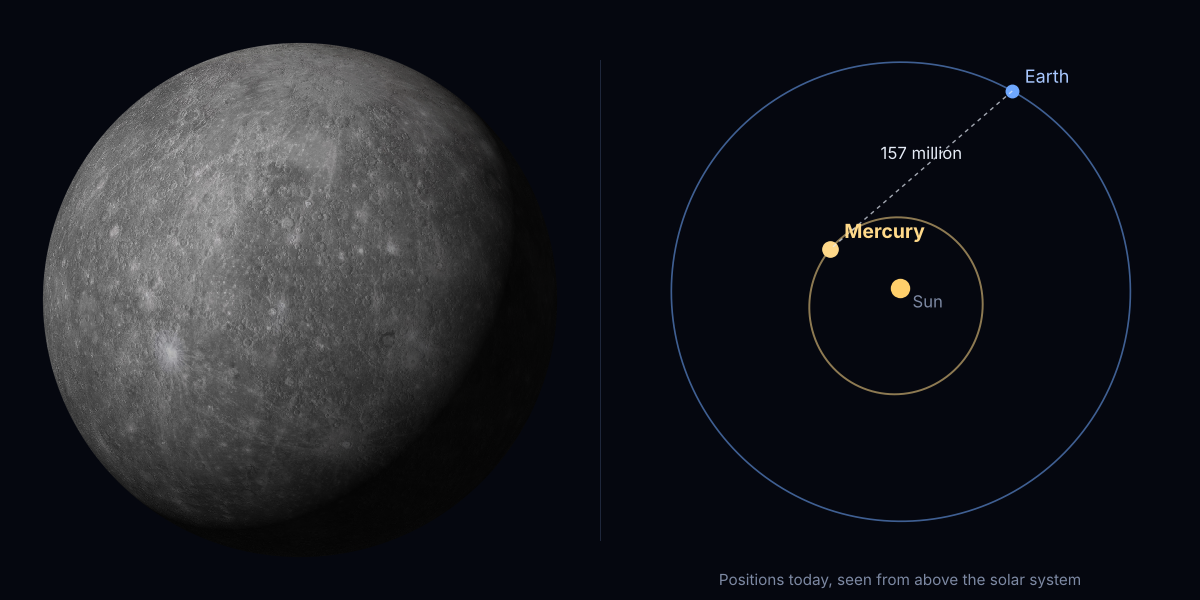
The smallest planet and the closest to the Sun, with the most stretched and tilted orbit of the eight.
| Distance from Earth today | 157,143,809 km (1.050 au) |
|---|---|
| Light travel time | 8.7 minutes |
| In the sky now | in the morning sky before sunrise |
| Diameter | 4,879 km (0.38 × Earth) |
| Mass | 0.0553 × Earth |
| Gravity | 3.7 m/s² (0.38 × Earth) |
| Length of a day (sunrise to sunrise) | 176 Earth days |
| Length of a year | 88 days |
| Average temperature | 167 °C |
| Average distance from the Sun | 57.9 million km |
| Moons | none |
Why does the distance to Mercury change so much?
Both planets go round the Sun at different speeds, so the gap swings between when they are on the same side of the Sun and when they are on opposite sides. From 23 November 2026 to 24 November 2029 it ranges from 82 to 217 million km, a factor of 2.6.
How long does it take to get to Mercury?
Light takes 8.7 minutes today. MESSENGER took 6.6 years (2004 to orbit in 2011), using six planetary flybys to shed speed; BepiColombo takes about 7 years. Spacecraft never fly straight there. They follow curved orbits around the Sun, timed so the planet is waiting when they arrive.
When is Mercury best seen?
- 1 January 2027: in line with the Sun (conjunction), so not visible
- 3 February 2027: greatest evening elongation, 18° from the Sun and best seen after sunset
- 19 February 2027: in line with the Sun (conjunction), so not visible
- 17 March 2027: greatest morning elongation, 28° from the Sun and best seen before sunrise
- 29 April 2027: in line with the Sun (conjunction), so not visible
- 28 May 2027: greatest evening elongation, 23° from the Sun and best seen after sunset
- 23 June 2027: in line with the Sun (conjunction), so not visible
- 16 July 2027: greatest morning elongation, 21° from the Sun and best seen before sunrise
Mercury’s distance from Earth over the next three years
| Date | Million km | Light time |
|---|---|---|
| 23 November 2026 | 157 | 8.7 minutes |
| 23 January 2027 | 184 | 10.2 minutes |
| 25 March 2027 | 154 | 8.6 minutes |
| 25 May 2027 | 134 | 7.4 minutes |
| 25 July 2027 | 161 | 8.9 minutes |
| 24 September 2027 | 149 | 8.3 minutes |
| 24 November 2027 | 204 | 11.3 minutes |
| 24 January 2028 | 121 | 6.7 minutes |
| 25 March 2028 | 191 | 10.6 minutes |
| 25 May 2028 | 88 | 4.9 minutes |
| 25 July 2028 | 200 | 11.1 minutes |
| 24 September 2028 | 103 | 5.8 minutes |
| 24 November 2028 | 217 | 12.1 minutes |
| 24 January 2029 | 107 | 5.9 minutes |
| 26 March 2029 | 202 | 11.2 minutes |
| 26 May 2029 | 92 | 5.1 minutes |
| 26 July 2029 | 186 | 10.3 minutes |
| 25 September 2029 | 117 | 6.5 minutes |
Cite this page: “How far away is Mercury? Distance today, facts and when to see it”, Atlas of the Cosmos, updated 2026-11-23, https://www.atlasofthecosmos.com/planets/mercury. The figures are also data (JSON).
Sources: NASA Planetary Fact Sheet; positions from JPL's approximate planetary orbits (Standish), good to a fraction of a degree. Reuse under CC BY 4.0 with credit to Atlas of the Cosmos. About the data · All planets