Planetary system
Kepler-758
Last updated 2026-11-23
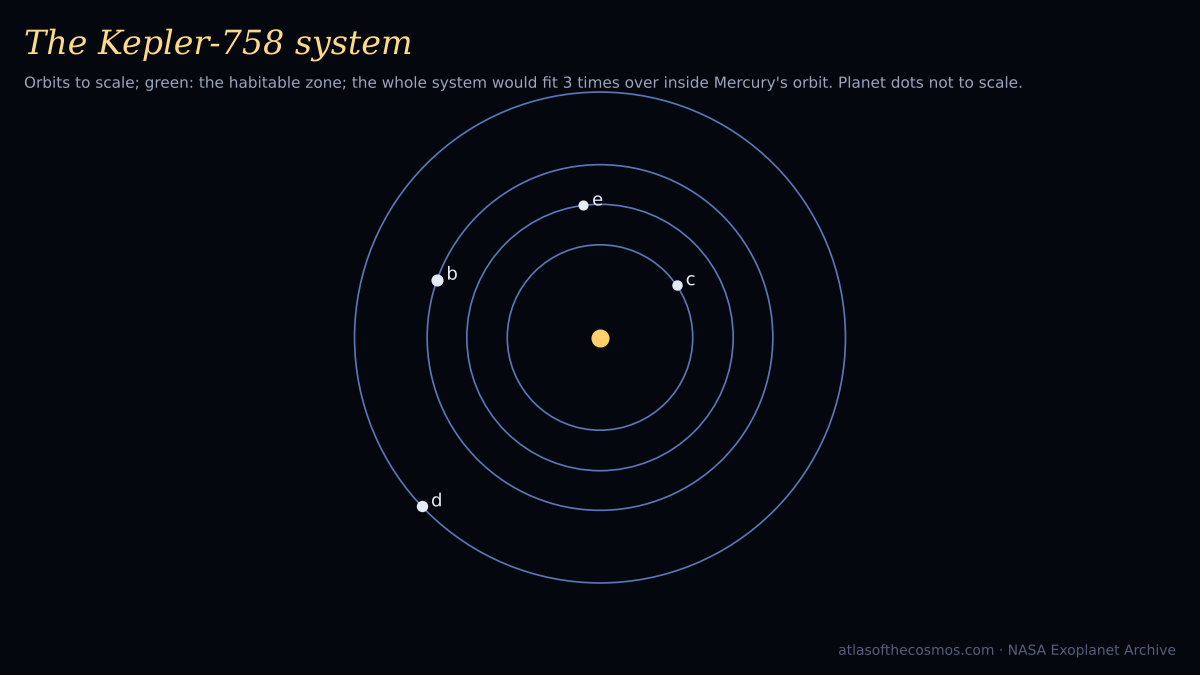
Kepler-758 is a hot star about 4,900 light-years away with 4 known planets.
The planets
| Planet | Size | From the star | Year | Temperature (est.) | Confirmed |
|---|---|---|---|---|---|
| c | 1.7 × Earth's width (super-Earth) | 0.05817 au | 4.8 days | 1212 °C | 2016, Transit |
| e | 1.5 × Earth's width (super-Earth) | 0.08357 au | 8.2 days | 966 °C | 2016, Transit |
| b | 2.5 × Earth's width (sub-Neptune) | 0.10844 au | 12.1 days | 815 °C | 2016, Transit |
| d | 2.1 × Earth's width (sub-Neptune) | 0.15401 au | 20.5 days | 640 °C | 2016, Transit |
Temperature is the equilibrium estimate (no greenhouse effect; Earth's would be about −18 °C). Sizes from transits; masses from radial velocity are minimums. au: the Earth–Sun distance.
The star
| Distance | 4,899.91 light-years |
|---|---|
| Star | 6,228 K surface |
| Star's size | 1.4 × the Sun's width |
| Star's brightness | 2.73 × the Sun's |
| Stars in the system | 1 |
| Habitable zone (conservative) | 1.57 to 2.76 au |
How long would it take to get there?
Light takes 4,899.9 years. Voyager 1, at 17 km/s, would need about 86,402,275 years. Even the fastest spacecraft so far, Parker Solar Probe at 192 km/s near the Sun, would take about 7,650,201 years.
Data: NASA Exoplanet Archive (default solutions), updated weekly. "Habitable zone" means liquid water could exist on the surface given a suitable atmosphere, not that anything lives there. All exoplanets · About the data