Planetary system
Kepler-304
Last updated 2026-11-23
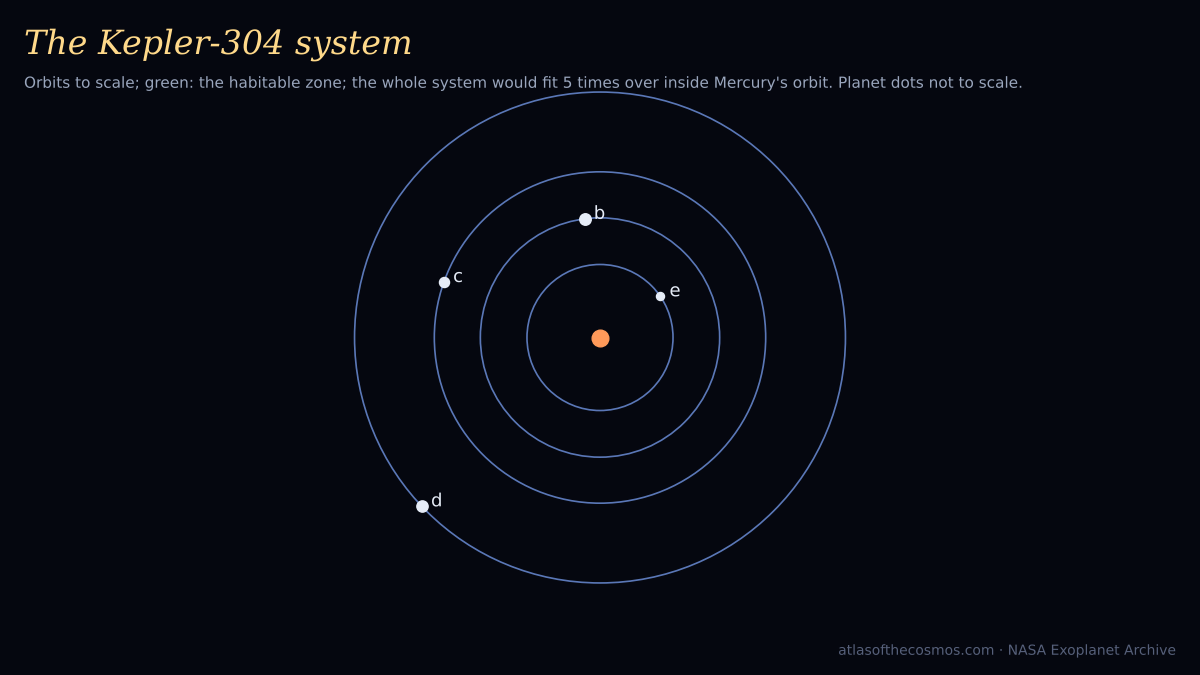
Kepler-304 is a orange dwarf about 1,418 light-years away with 4 known planets.
The planets
| Planet | Size | From the star | Year | Temperature (est.) | Confirmed |
|---|---|---|---|---|---|
| e | 1.2 × Earth's width (Earth-sized) | 0.0238 au | 1.5 days | 1015 °C | 2016, Transit |
| b | 2.9 × Earth's width (sub-Neptune) | 0.039 au | 3.3 days | 733 °C | 2014, Transit |
| c | 2.2 × Earth's width (sub-Neptune) | 0.054 au | 5.3 days | 582 °C | 2014, Transit |
| d | 2.8 × Earth's width (sub-Neptune) | 0.08 au | 9.7 days | 429 °C | 2014, Transit |
Temperature is the equilibrium estimate (no greenhouse effect; Earth's would be about −18 °C). Sizes from transits; masses from radial velocity are minimums. au: the Earth–Sun distance.
The star
| Distance | 1,417.75 light-years |
|---|---|
| Star | 4,817 K surface |
| Star's size | 0.73 × the Sun's width |
| Star's brightness | 0.258 × the Sun's |
| Stars in the system | 1 |
| Habitable zone (conservative) | 0.483 to 0.849 au |
How long would it take to get there?
Light takes 1,417.7 years. Voyager 1, at 17 km/s, would need about 24,999,791 years. Even the fastest spacecraft so far, Parker Solar Probe at 192 km/s near the Sun, would take about 2,213,523 years.
Data: NASA Exoplanet Archive (default solutions), updated weekly. "Habitable zone" means liquid water could exist on the surface given a suitable atmosphere, not that anything lives there. All exoplanets · About the data