Barnard's star
Last updated 2026-11-23
Barnard's star is a red dwarf 6.0 light-years away with 4 known planets.
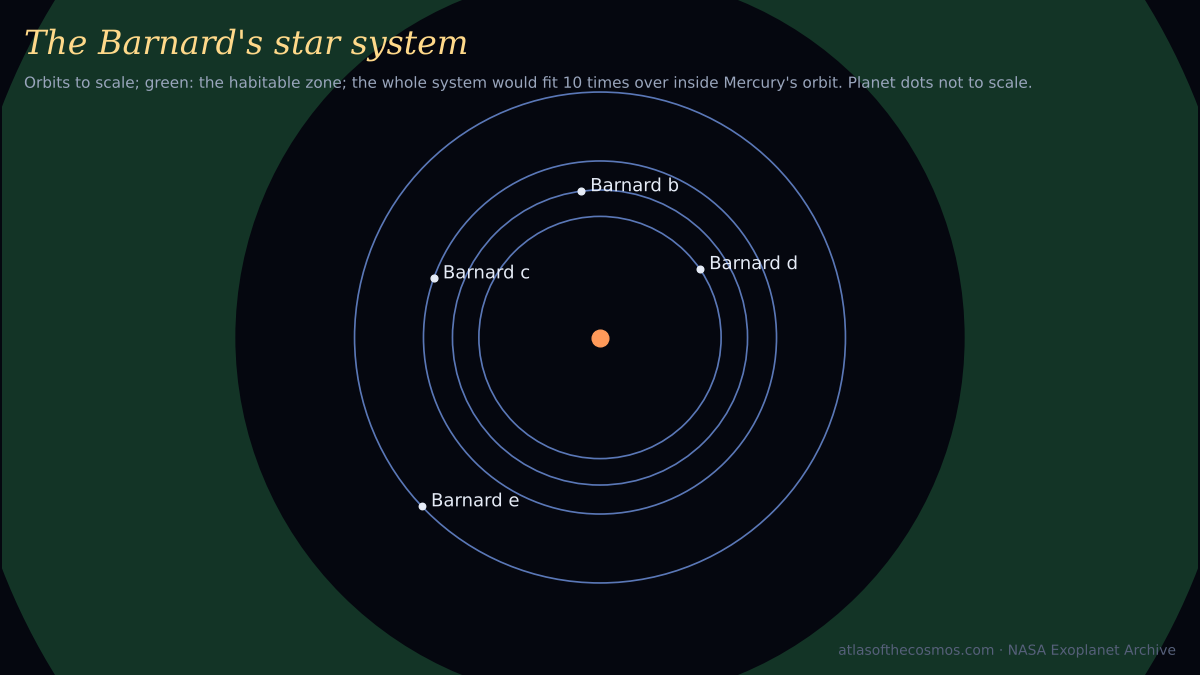
The second-nearest star system to the Sun after Alpha Centauri. Four small planets were confirmed in 2024 and 2025, all closer to the star than Mercury is to the Sun.
The planets
| Planet | Size | From the star | Year | Temperature (est.) | Confirmed |
|---|---|---|---|---|---|
| Barnard d | at least 0.26 × Earth's mass (rocky-sized) | 0.0188 au | 2.3 days | 210 °C | 2025, Radial Velocity |
| Barnard b | at least 0.3 × Earth's mass (rocky-sized) | 0.0229 au | 3.2 days | 165 °C | 2024, Radial Velocity |
| Barnard c | at least 0.34 × Earth's mass (rocky-sized) | 0.0274 au | 4.1 days | 127 °C | 2025, Radial Velocity |
| Barnard e | at least 0.19 × Earth's mass (rocky-sized) | 0.0381 au | 6.7 days | 67 °C | 2025, Radial Velocity |
Temperature is the equilibrium estimate (no greenhouse effect; Earth's would be about −18 °C). Sizes from transits; masses from radial velocity are minimums. au: the Earth–Sun distance.
The star
| Distance | 5.96 light-years |
|---|---|
| Star | M3.5-4 V · 3,195 K surface |
| Star's size | 0.18 × the Sun's width |
| Star's brightness | 0.00355 × the Sun's |
| Stars in the system | 1 |
| Habitable zone (conservative) | 0.0566 to 0.0995 au |
How long would it take to get there?
Light takes 6.0 years. Voyager 1, at 17 km/s, would need about 105,050 years. Even the fastest spacecraft so far, Parker Solar Probe at 192 km/s near the Sun, would take about 9,301 years.
Data: NASA Exoplanet Archive (default solutions), updated weekly. "Habitable zone" means liquid water could exist on the surface given a suitable atmosphere, not that anything lives there. All exoplanets · About the data