Total solar eclipse of 2 September 2035
By David Turner · Last updated 2026-11-23
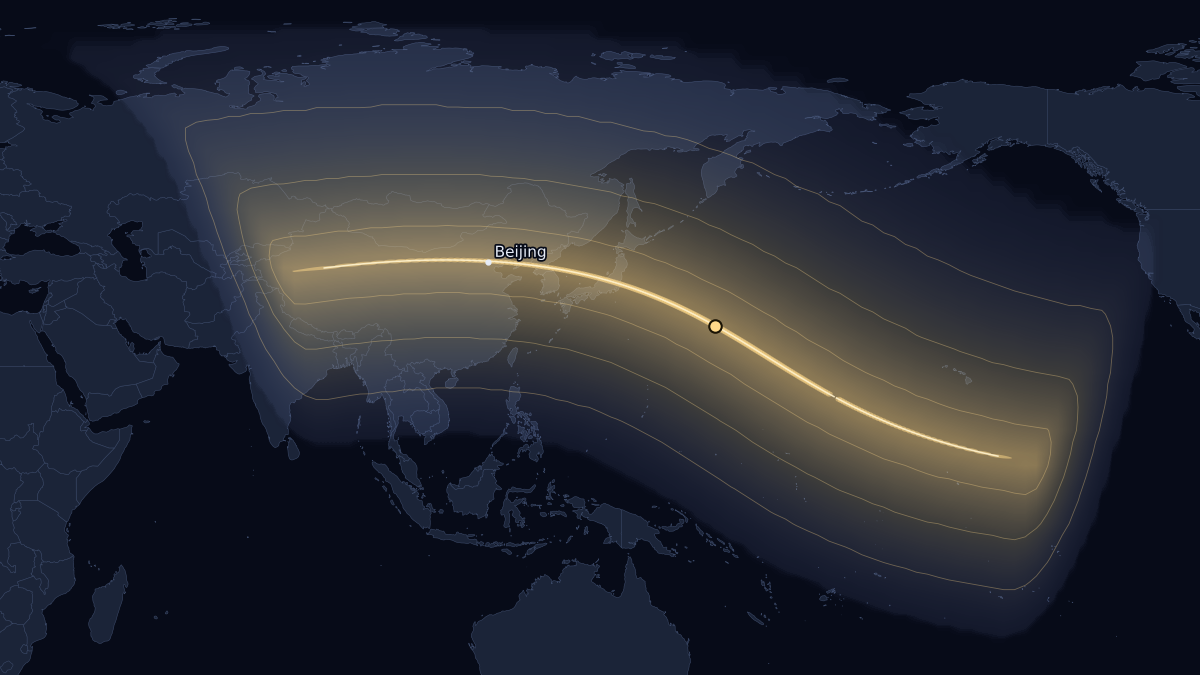
The total solar eclipse of 2 September 2035 crosses China, North Korea, South Korea and Japan. Totality lasts up to 2 min 57 s, longest at 29.0°N, 158.1°E at 01:56 UTC.
| Type | Total solar eclipse |
|---|---|
| Date | 2 September 2035 |
| Greatest eclipse | 01:56 UTC |
| Longest totality | 2 min 57 s |
| Where it is longest | 29.03, 158.11 |
| Big towns in the central path | 63 |
| Countries that see some eclipse | 27 |
Which cities are in the path of totality?
The 25 biggest of 63 towns of 50,000 people or more inside the central path, with how long it lasts there and how high the Sun is. Times are UTC.
| Place | Lasts | Middle (UTC) | Sun height |
|---|---|---|---|
| Beijing, China | 1 min 35 s | 00:32 | 32° |
| Tangshan, China | 49 s | 00:34 | 33° |
| Qinhuangdao, China | 1 min 58 s | 00:36 | 35° |
| Pyongyang, North Korea | 1 min 47 s | 00:43 | 41° |
| Baotou, China | 57 s | 00:27 | 26° |
| Xiping, China | 1 min 37 s | 00:29 | 29° |
| Xibeijie, China | 51 s | 00:20 | 16° |
| Wafangdian, China | 2 min 01 s | 00:38 | 37° |
| Zhuanghe, China | 2 min 02 s | 00:40 | 38° |
| Zunhua, China | 1 min 47 s | 00:34 | 33° |
| Qian'an, China | 1 min 56 s | 00:35 | 34° |
| Sanhe, China | 1 min 49 s | 00:33 | 32° |
| Xinxing, China | 1 min 01 s | 00:42 | 39° |
| Changping, China | 1 min 50 s | 00:32 | 31° |
| Luanzhou, China | 1 min 36 s | 00:35 | 34° |
| Utsunomiya, Japan | 2 min 31 s | 01:07 | 55° |
| Sunch'on, North Korea | 2 min 02 s | 00:44 | 41° |
| Kashiwa, Japan | 36 s | 01:08 | 55° |
| Toyama, Japan | 1 min 27 s | 01:03 | 53° |
| Zhangjiakou Shi Xuanhua Qu, China | 34 s | 00:32 | 30° |
| Takasaki, Japan | 2 min 01 s | 01:06 | 54° |
| Nagano, Japan | 2 min 20 s | 01:04 | 53° |
| Yanjiao, China | 1 min 44 s | 00:33 | 32° |
| Wonsan, North Korea | 2 min 09 s | 00:46 | 42° |
| Yingmen, China | 1 min 20 s | 00:19 | 15° |
Of the big towns, Chikusei (Japan) gets the longest: 2 min 37 s.
How much of the Sun is covered in major cities?
The biggest cities that see at least some eclipse, with the deepest moment.
| City | Sun covered | Deepest (UTC) | Sun height |
|---|---|---|---|
| Tokyo, Japan | 99% | 01:08 | 55° |
| Delhi, India | 41% | 00:33 | 0° |
| Guangzhou, China | 36% | 00:23 | 30° |
| Manila, Philippines | 11% | 00:36 | 41° |
| Shanghai, China | 69% | 00:36 | 39° |
| Seoul, South Korea | 97% | 00:45 | 42° |
| Dhaka, Bangladesh | 43% | 00:07 | 5° |
| Beijing, China | 100% (total) | 00:32 | 32° |
| Kolkata, India | 39% | 00:07 | 3° |
| Bangkok, Thailand | 9% | 00:10 | 15° |
| Shenzhen, China | 34% | 00:24 | 31° |
| Ho Chi Minh City, Vietnam | 2% | 00:15 | 22° |
| Osaka, Japan | 92% | 01:00 | 52° |
| Chengdu, China | 65% | 00:16 | 20° |
| Chennai, India | 4% | 00:31 | 0° |
| Xi'an, China | 78% | 00:22 | 25° |
| Lahore, Pakistan | 33% | 00:42 | 0° |
| Chongqing, China | 60% | 00:18 | 22° |
| Baoding, China | 97% | 00:31 | 31° |
| Linyi, China | 83% | 00:32 | 34° |
| Dongguan, China | 36% | 00:23 | 30° |
| Hyderabad, India | 10% | 00:35 | 0° |
| Tianjin, China | 99% | 00:33 | 33° |
| Wuhan, China | 64% | 00:26 | 31° |
| Nanyang, China | 74% | 00:25 | 29° |
Which countries can see it?
Some eclipse is visible from 27 countries with a town of 50,000 or more. The deepest: Japan (100%), China (100%), South Korea (100%), North Korea (100%), Russia (85%), Kyrgyzstan (85%), Kazakhstan (81%), Mongolia (74%), India (62%), Nepal (62%), United States (60%) and Bhutan (57%).
How do you watch it safely?
Never look at the Sun directly, even when most of it is covered. Use eclipse glasses that meet ISO 12312-2, or a pinhole projector. Only during totality itself, when the Sun is completely covered, is it safe to look without them, and the glasses go back on the moment the first bright edge returns.
Open it on the live mapCite this page: “Total solar eclipse of 2 September 2035”, Atlas of the Cosmos, updated 2026-11-23, https://www.atlasofthecosmos.com/eclipses/2035-09-02-solar. The figures are also data (JSON).
Sources: NASA/JPL Horizons positions of the Sun and Moon, our own shadow geometry, Natural Earth borders and towns of 50,000 or more. Reuse under CC BY 4.0 with credit to Atlas of the Cosmos. About the data · All eclipses