Corvus
Last updated 2026-11-23
Corvus is the crow. It lies in the band around the celestial equator, so most of it can be seen from nearly everywhere, and is best seen in the evening around May. Its brightest star is Gienah (magnitude 2.6, 154 light-years away).
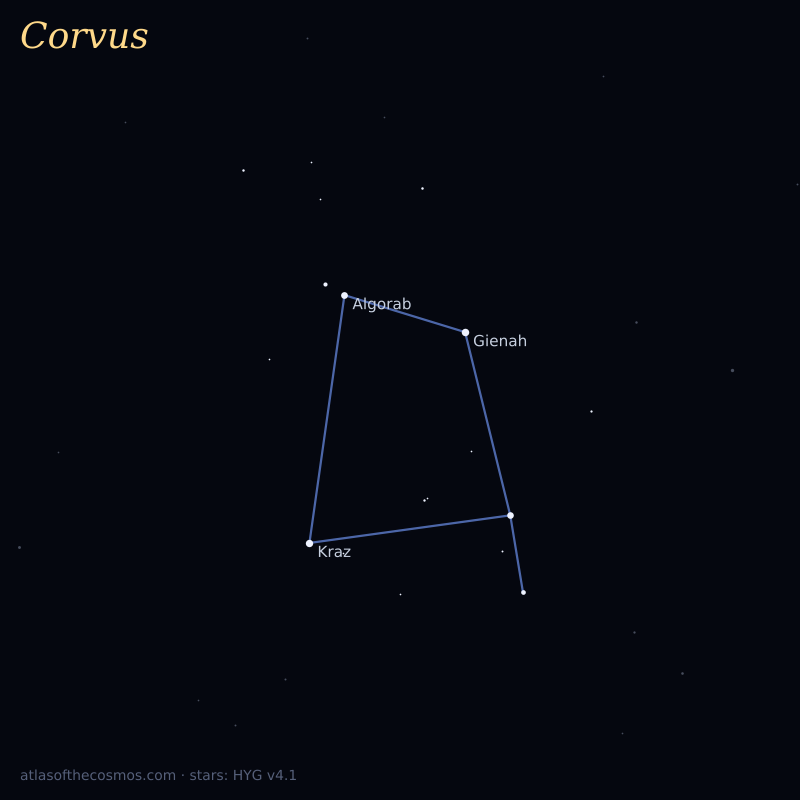
When and where can you see Corvus?
It is highest in the evening sky around May, and in the early morning a few months earlier. The whole constellation rises at some time of year from anywhere between 65°N and the South Pole. Part of it can be seen as far as 77°N.
The brightest stars in Corvus
Magnitude: lower is brighter; the faintest stars visible from a dark site are about 6. Distances in light-years.
| Star | Magnitude | Distance | Type |
|---|---|---|---|
| Gienah | 2.58 | 154 ly | B8III |
| Kraz | 2.65 | 146 ly | G5II |
| Algorab | 2.94 | 87 ly | B9.5V |
| ε Corvi | 3.02 | 318 ly | K2III |
| Alchiba | 4.02 | 49 ly | F0IV/V |
| η Corvi | 4.30 | 60 ly | F2V |
| ζ Corvi | 5.20 | 415 ly | B8V |
| 3 Corvi | 5.45 | 192 ly | A1V |
| 6 Corvi | 5.66 | 331 ly | K1III |
See if it is up tonight where you are
Stars from the HYG database v4.1 (Hipparcos, Yale, Gliese); distances beyond a few hundred light-years are uncertain by 10 to 20 percent. Figure lines as drawn on Atlas of the Cosmos’s map; the IAU defines the constellation’s boundaries, not its lines. All 88 constellations · The brightest stars