Canis Major
Last updated 2026-11-23
Canis Major is the great dog. It lies in the southern sky, and is best seen in the evening around February. Its brightest star is Sirius (magnitude -1.4, 9 light-years away).
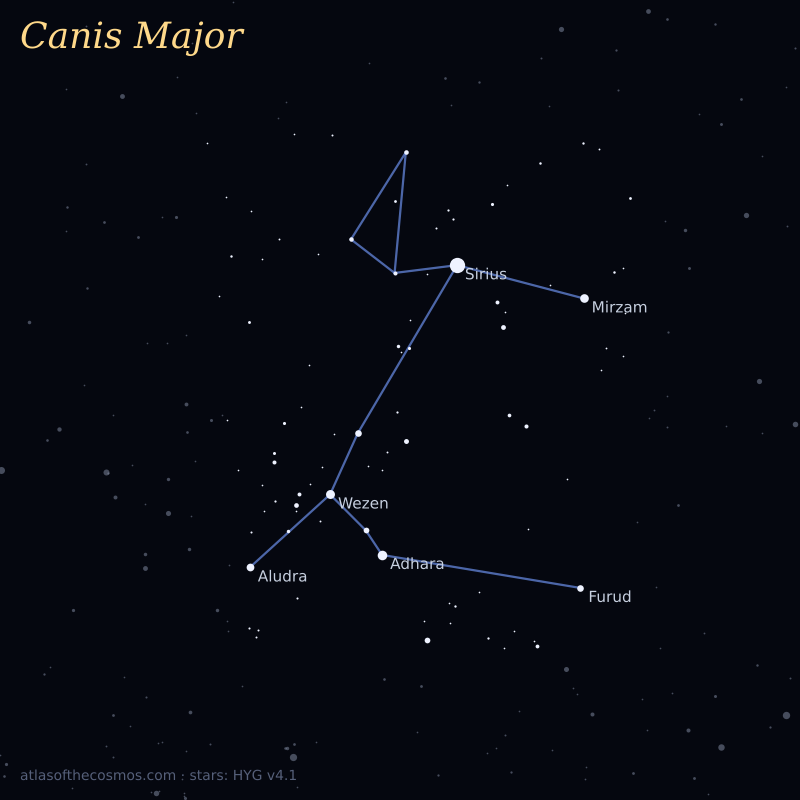
When and where can you see Canis Major?
It is highest in the evening sky around February, and in the early morning a few months earlier. The whole constellation rises at some time of year from anywhere between 57°N and the South Pole. Part of it can be seen as far as 73°N.
The brightest stars in Canis Major
Magnitude: lower is brighter; the faintest stars visible from a dark site are about 6. Distances in light-years.
| Star | Magnitude | Distance | Type |
|---|---|---|---|
| Sirius | -1.44 | 9 ly | A0m... |
| Adhara | 1.50 | 405 ly | B2II |
| Wezen | 1.83 | 1,607 ly | F8Ia |
| Mirzam | 1.98 | 493 ly | B1II/III |
| Aludra | 2.45 | 1,989 ly | B5Ia |
| Furud | 3.02 | 362 ly | B2.5V |
| ο Canis Majoris | 3.02 | 2,764 ly | B3Ia |
| Nganurganity | 3.49 | 1,121 ly | K4III |
| κ Canis Majoris | 3.50 | 659 ly | B1.5IVne |
| ο Canis Majoris | 3.89 | ? | K3Iab |
| ν Canis Majoris | 3.95 | 64 ly | K1III+.. |
| ω Canis Majoris | 4.01 | 911 ly | B2IV/Ve |
See if it is up tonight where you are
Stars from the HYG database v4.1 (Hipparcos, Yale, Gliese); distances beyond a few hundred light-years are uncertain by 10 to 20 percent. Figure lines as drawn on Atlas of the Cosmos’s map; the IAU defines the constellation’s boundaries, not its lines. All 88 constellations · The brightest stars