Camelopardalis
Last updated 2026-11-23
Camelopardalis is the giraffe. It lies in the northern sky, and is best seen in the evening around January. Its brightest star is β Camelopardalis (magnitude 4.0, 872 light-years away).
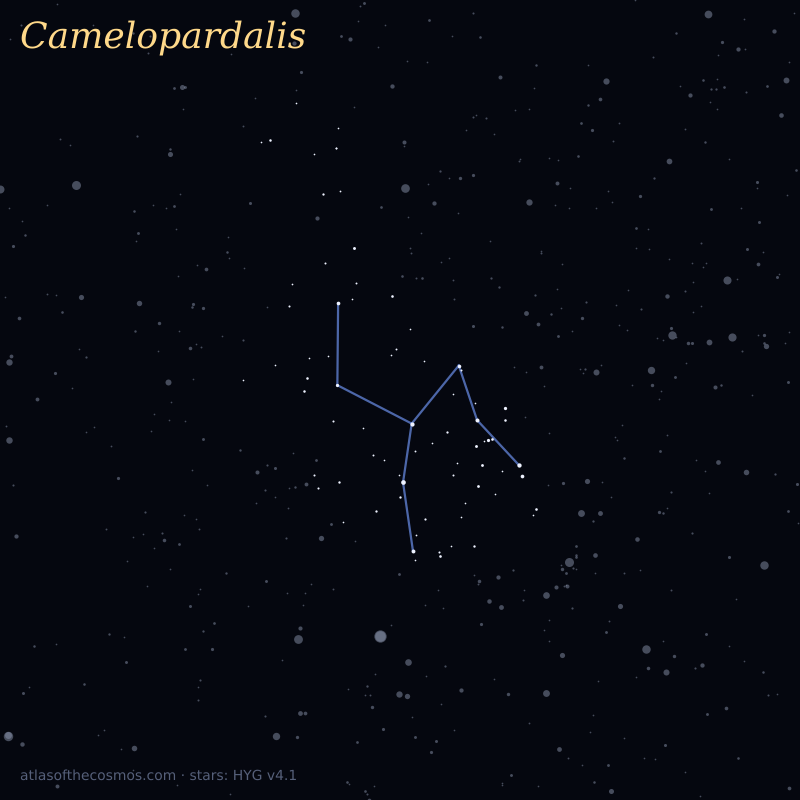
When and where can you see Camelopardalis?
It is highest in the evening sky around January, and in the early morning a few months earlier. The whole constellation rises at some time of year from anywhere between the North Pole and 8°S. Part of it can be seen as far as 36°S.
The brightest stars in Camelopardalis
Magnitude: lower is brighter; the faintest stars visible from a dark site are about 6. Distances in light-years.
| Star | Magnitude | Distance | Type |
|---|---|---|---|
| β Camelopardalis | 4.03 | 872 ly | G0Ib |
| α Camelopardalis | 4.26 | ? | O9.5Ia S |
| 7 Camelopardalis | 4.43 | 372 ly | A1V |
| γ Camelopardalis | 4.59 | 359 ly | A2IVn |
| 3 Camelopardalis | 5.07 | 422 ly | K0III SB |
| 43 Camelopardalis | 5.11 | 979 ly | B7III |
| 42 Camelopardalis | 5.14 | 924 ly | B4IV |
| 31 Camelopardalis | 5.20 | 469 ly | A2V |
| 11 Camelopardalis | 5.22 | 685 ly | B2.5Ve |
| 16 Camelopardalis | 5.24 | 336 ly | A0Vn |
| 4 Camelopardalis | 5.29 | 172 ly | A3m |
| 37 Camelopardalis | 5.35 | 381 ly | G8III |
See if it is up tonight where you are
Stars from the HYG database v4.1 (Hipparcos, Yale, Gliese); distances beyond a few hundred light-years are uncertain by 10 to 20 percent. Figure lines as drawn on Atlas of the Cosmos’s map; the IAU defines the constellation’s boundaries, not its lines. All 88 constellations · The brightest stars