Auriga
Last updated 2026-11-23
Auriga is the charioteer. It lies in the northern sky, and is best seen in the evening around January. Its brightest star is Capella (magnitude 0.1, 43 light-years away).
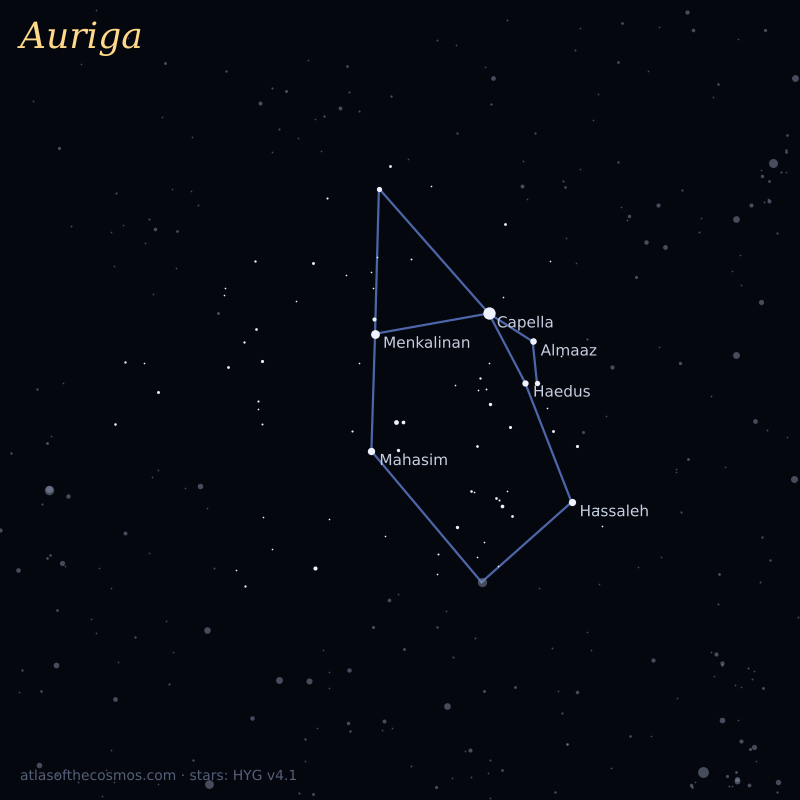
When and where can you see Auriga?
It is highest in the evening sky around January, and in the early morning a few months earlier. The whole constellation rises at some time of year from anywhere between the North Pole and 36°S. Part of it can be seen as far as 61°S.
The brightest stars in Auriga
Magnitude: lower is brighter; the faintest stars visible from a dark site are about 6. Distances in light-years.
| Star | Magnitude | Distance | Type |
|---|---|---|---|
| Capella | 0.08 | 43 ly | M1: comp |
| Menkalinan | 1.90 | 81 ly | A2V |
| Mahasim | 2.65 | 166 ly | A0p Si |
| Hassaleh | 2.69 | 493 ly | K3IIvar |
| Almaaz | 3.03 | 2,132 ly | F0Ia |
| Haedus | 3.18 | 243 ly | B3V |
| Saclateni | 3.69 | 786 ly | K4II com |
| δ Aurigae | 3.72 | 126 ly | K0III |
| ν Aurigae | 3.97 | 230 ly | K0III |
| π Aurigae | 4.30 | 752 ly | M3IIvar |
| κ Aurigae | 4.32 | 177 ly | G8IIIvar |
| τ Aurigae | 4.51 | 207 ly | G8III |
See if it is up tonight where you are
Stars from the HYG database v4.1 (Hipparcos, Yale, Gliese); distances beyond a few hundred light-years are uncertain by 10 to 20 percent. Figure lines as drawn on Atlas of the Cosmos’s map; the IAU defines the constellation’s boundaries, not its lines. All 88 constellations · The brightest stars