Andromeda
Last updated 2026-11-23
Andromeda is the chained princess of Greek myth. It lies in the northern sky, and is best seen in the evening around November. Its brightest star is Alpheratz (magnitude 2.1, 97 light-years away).
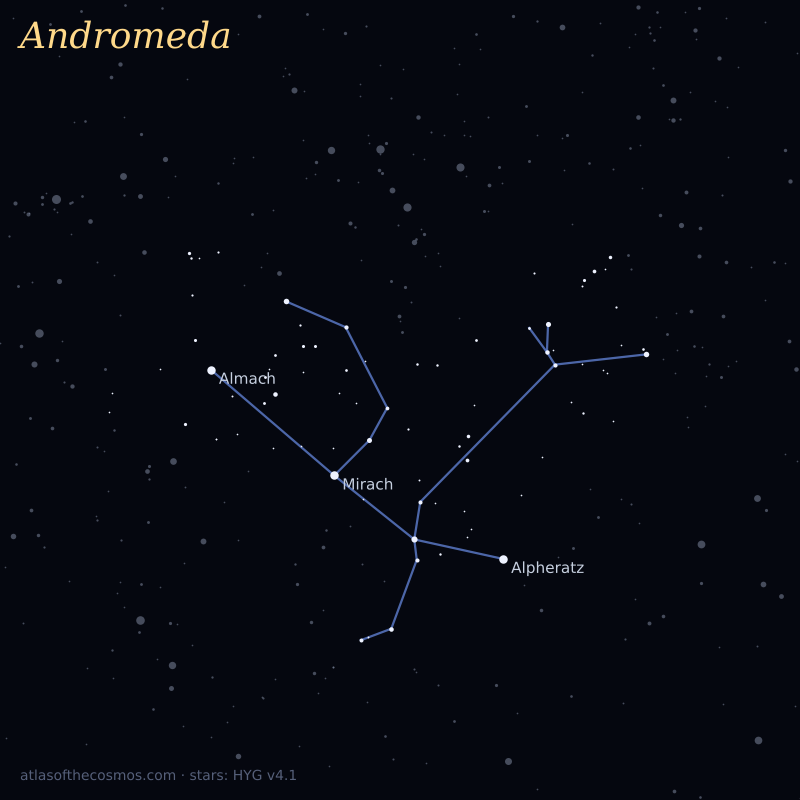
When and where can you see Andromeda?
It is highest in the evening sky around November, and in the early morning a few months earlier. The whole constellation rises at some time of year from anywhere between the North Pole and 41°S. Part of it can be seen as far as 66°S.
The brightest stars in Andromeda
Magnitude: lower is brighter; the faintest stars visible from a dark site are about 6. Distances in light-years.
| Star | Magnitude | Distance | Type |
|---|---|---|---|
| Alpheratz | 2.07 | 97 ly | B9p |
| Mirach | 2.07 | 197 ly | M0IIIvar |
| Almach | 2.10 | 393 ly | B8V |
| δ Andromedae | 3.27 | 106 ly | K3III... |
| Nembus | 3.59 | 177 ly | K3III |
| ο Andromedae | 3.62 | 687 ly | B6pv SB |
| λ Andromedae | 3.81 | 86 ly | G8III-IV |
| μ Andromedae | 3.86 | 130 ly | A5V |
| ζ Andromedae | 4.08 | 189 ly | K1II |
| Titawin | 4.10 | 44 ly | F8V |
| κ Andromedae | 4.15 | 168 ly | B9IVn |
| φ Andromedae | 4.26 | 717 ly | B7III |
See if it is up tonight where you are
Stars from the HYG database v4.1 (Hipparcos, Yale, Gliese); distances beyond a few hundred light-years are uncertain by 10 to 20 percent. Figure lines as drawn on Atlas of the Cosmos’s map; the IAU defines the constellation’s boundaries, not its lines. All 88 constellations · The brightest stars